Swedish Embassy Inspired by JEC Impact and Women’s Transformation in Gbarpolu as Traditional Arts School Replaces FGM

PARKER TOWN, Gbarma District — What began as a routine joint monitoring visit to Gbarpolu County became an emotional moment no one in the delegation would forget. Standing before dozens of women proudly weaving Liberian country cloth at the county’s first Traditional Arts School, a Gender & human rights program coordinator from the Swedish Embassy in Liberia paused mid-speech, overcome with emotion.
Her voice trembled as she paused her remarks while her eyes watered, she said slowly,
"I have been working with this project since 2019 and watching the women do something for themselves and take charge of their lives in Gbarpolu; where we know the culture (FGM) is very strong and watching the community, the leadership, the elders, supporting you, I am very moved by this." Dwede Tarpeh told the gather.
What the SIDA team witnessed in Parker Town was more than a development project. It was a community rewriting its future. transitional from traditional harmful practice to more economic and sustainable livelihood. Additionally, which impact further motivated the County Development council to make budgetary allocation in the 2026 fiscal budget to replicate this intervention to other districts across Gbarpolu.
Once known as a place where harmful traditional practices such as Female Genital Mutilation (FGM) thrived, Gbarma District is now emerging as a symbol of transformation, women’s empowerment, and cultural transition through the Just and Equal Communities (JEC) Project being implemented by ActionAid Liberia and its local partner, DOMAFEIGN, with support from Sweden.
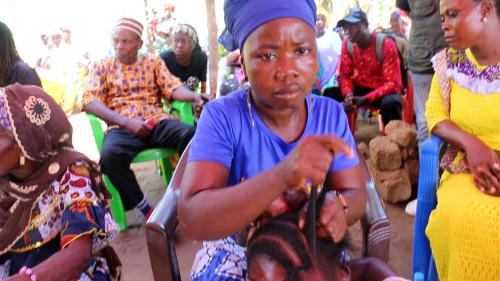
In front of the delegation sat women who were once survivors of FGM, former practitioners, and marginalized community members. Today, they are artisans, mentors, entrepreneurs, and advocates for change. Side by side, they worked confidently on looms, braiding hair, producing mats, weaving baskets, and making fishing nets, all while learning about their rights and economic independence.
The representative added: “What strikes me is that the women already had skills and great power among them. The project has helped them use those skills and that power to change their lives. We are very impressed and thankful that we could be here, and we are thankful to ActionAid and its local partner DOMAFEIGN.”
The emotional visit marked one of the final field engagements of the Swedish Embassy in Liberia before its closure, making the moment even more significant for both the delegation and the community.
Before the JEC project arrived in Gbarma, many women had little or no access to livelihood opportunities or information about their sexual and reproductive health and rights. Former FGM practitioners depended on the traditional bush school system for survival, while girls and women often had no voice in decisions affecting their lives.
Today, that reality is rapidly changing.
The Traditional Arts School, launched earlier this year by ActionAid Liberia and DOMAFEIGN, is providing an alternative cultural education model that promotes positive traditional values without harmful practices. The pilot phase has already enrolled 40 women and girls, including survivors and former practitioners of FGM.
The school teaches country cloth weaving, tailoring, basket-making, and other vocational skills aimed at building sustainable livelihoods for women and girls.
Speaking during the visit, DOMAFEIGN Program Coordinator, Foxter Jenemana, said the initiative has broken longstanding social barriers within the community.
He continued: “The FGM practice that was here has now transitioned into a women’s economic empowerment program.”
Genemaneh also called for additional support to expand the initiative, particularly for the cultivation of a 25-acre piece of land donated by the community for cotton production.
“We want support for this art school and for the cultivation of the 25 acres of land for cotton production to make Liberian-made country clothes,” he added.
The donation of land by Parker Town residents is being viewed as a powerful sign of community ownership and commitment to sustaining the transition away from harmful traditional practices.
ActionAid Liberia’s Country Director, Elizabeth Gbah Johnson, praised the people of Gbarma for embracing change and ensuring the sustainability of the initiative.
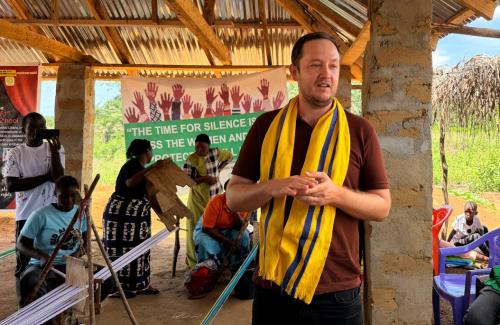
“From the bottom of our hearts, we want to say thank you because what you have done is not just establish this school, but you have also created a process where this county now has an allocation in its annual budget to ensure this school continues,” she added. “This is what we talk about when we speak of sustainability.”
Johnson further praised local authorities and the Ministry of Local Government for supporting the initiative and working closely with ActionAid and its partners.
Speaking on behalf of the Liberian government, Assistant Minister for Culture, Hon. William Jallah, thanked Sweden for its years of support to Liberia and praised the women of Parker Town for transforming their lives.
“The Swedish government has always supported this country. Our citizens are so grateful,” Minister Jallah said. “What the women have started the Traditional Arts School and the making of these Liberian-designed country clothes are all because of your support. You can see what is happening.”
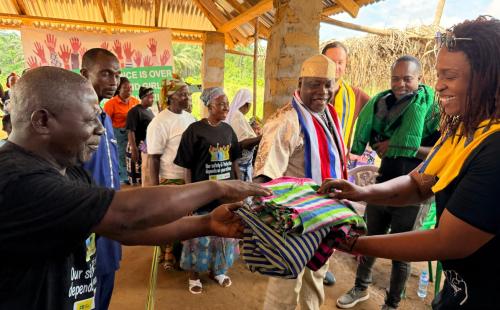
Minister Jallah made the remarks after being presented with a Liberian-made country cloth gown produced by former FGM practitioners, survivors, and women enrolled at the school.
For many in Parker Town, the transformation goes beyond economic empowerment. It is about restoring dignity, protecting girls, and creating opportunities that were once unimaginable.
As the Swedish delegation prepared to depart, the message from Gbarma was unmistakable: when communities invest in women and girls, lasting change becomes possible.
What was once a center of harmful practices is now becoming a beacon of hope, one woven thread at a time.