Press Statement-ActionAid Liberia Says PERIOD POVERTY IS A POLICY FAILURE: Calls for Passage of the Sanitary Pad Tax Exemption Act

With an Urgent Call to Action
MONROVIA, May 28, 2026 — On this World Menstrual Hygiene Day, ActionAid Liberia stands with the millions of girls and women across this country whose right to dignity, health, and education is being denied, not by circumstance, but by policy.
Every month, adolescent girls in Liberia's public schools face an invisible but devastating choice: go to school without adequate menstrual protection, or stay home. Many choose to stay home. This is not a personal failing. It is a national emergency, one manufactured by a 30 percent tax on sanitary pads, crumbling school WASH infrastructure, deep-rooted stigma, and a Legislature that has allowed a life-changing bill to gather dust in committee Room.
ActionAid Liberia says clearly: menstrual poverty is period poverty, and period poverty is a justice issue. It will not be resolved by charity. It demands political will and it demands it now.
live in poverty, and where the Sida 2024 multidimensional poverty index shows nearly 70 percent of people fall below the lower-middle-income threshold of US$3.65 per day.
The result is what advocates call 'period poverty': the inability to afford or access basic menstrual products. Unable to purchase pads, girls across Liberia turn to unsafe alternatives, old rags, socks, tissue, and discarded cloth, that expose them to infections, reproductive health complications, and the crushing weight of shame.
The absence of any menstrual support mechanism in public and private schools means girls manage their periods alone, in silence, or not at all.
The consequences compound into a full educational crisis. The United Nations and UNFPA estimate that one in ten girls in Sub-Saharan Africa skips school during her menstrual cycle, amounting to as much as 20 percent of the school year lost. In Liberia, this translates into weeks of missed lessons, falling academic performance, widening gender learning gaps, and, for too many girls, an exit from school altogether that is never reversed.
BROKEN INFRASTRUCTURE: NO TOILETS, NO DIGNITY, NO CHOICE
Even for girls who manage to obtain menstrual products, the school environment offers them no safe haven. Liberia's school WASH crisis is severe and well-documented:
● 1,790 schools nationwide have no toilets at all, affecting over 356,000 students — half of them girls (MoE Annual School Census 2024–2025, National Policy on Girls' Education Performance Analysis Report).
● Only 26.8 percent of schools in Liberia have access to basic sanitation services (Liberia Observer / JMP data 2025).
● UNICEF confirms that the absence of separate girls' bathrooms in Liberian schools actively discourages menstruating girls from attending school and contributes directly to school dropout.
● Liberia loses an estimated US$231 million annually due to poor WASH services, equivalent to 5.3 percent of GDP — and 67 percent of the benefits of improved WASH would go directly to women and girls (WaterAid Liberia Cost-Benefit Analysis, July 2025).
● Between 2020 and 2024, Liberia allocated just US$1 million of its national budget to WASH annually — a mere 0.03 percent of GDP.
For a girl menstruating in a school with no private toilet, no water, no soap, and no pad, attending school is not just uncomfortable — it is humiliating. Schools must be safe, dignified spaces for girls. Right now, for too many, they are not.
THE SILENCE THAT COSTS GIRLS THEIR FUTURES
Beyond infrastructure and affordability, menstruation in Liberia remains shrouded in stigma and silence. Many adolescent girls receive no comprehensive menstrual health education before their first period, leaving them frightened, misinformed, and dependent on myths and peer rumour. Without accurate knowledge, girls cannot make informed choices about their bodies, their hygiene, or their health. Schools, families, and communities often collude in this silence, treating menstruation as shameful rather than as a normal biological process deserving care and support.
Research across African rural schools (Frontiers in Reproductive Health, 2025) confirms that girls who receive menstrual health education and access to products demonstrate significantly improved school attendance, academic confidence, and readiness to seek health support. Liberia's schools can and must deliver this — but it requires political commitment, not just goodwill.
THE BILL: A LAW THAT COULD CHANGE EVERYTHING
A solution is within reach. The Sanitary Pad Tax Exemption Act of 2026, tabled by Representative Thomas Goshua, proposes to eliminate the 20 percent import duty and 10 percent goods and services tax currently applied to sanitary products , a combined tax burden of 30 percent that artificially inflates the price of a basic health necessity beyond what most Liberians can afford. The bill would reclassify menstrual hygiene products as essential health items, not general consumer goods.
The Malakai Foundation, YEAH-Liberia has joined ActionAid Liberia and the growing coalition of civil society organizations in calling for the bill's urgent passage.
The Community Healthcare Initiative previously petitioned the House of Representatives on the same issue. The scientific evidence, the economic evidence, and the human evidence are all on the same side. This bill has sat in committee for too long. Every day it is delayed, another girl chooses to stay at home rather than go to school without menstrual protection.
ActionAid Liberia further calls on the Legislature to go beyond tax exemption to institutionalize the provision of free or heavily subsidized menstrual products in public and under-funded private schools and to include menstrual health education as a mandatory component of the national curriculum. Tax relief is necessary. It is not sufficient.
"Menstrual hygiene is not a women’s issue. It is a human rights issue, an education issue, a health issue, and an economic justice issue. When we tax a girl’s period, we tax her right to learn. The Legislature must act, not next session, not next year. Now.
Produced By: ActionAid Liberia."
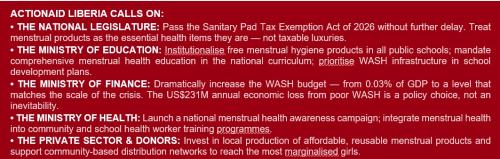
• THE NATIONAL LEGISLATURE: Pass the Sanitary Pad Tax Exemption Act of 2026 without further delay. Treat menstrual products as the essential health items they are — not taxable luxuries.
• THE MINISTRY OF EDUCATION: Institutionalise free menstrual hygiene products in all public schools; mandate comprehensive menstrual health education in the national curriculum; prioritise WASH infrastructure in school development plans.
• THE MINISTRY OF FINANCE: Dramatically increase the WASH budget — from 0.03% of GDP to a level that matches the scale of the crisis. The US$231M annual economic loss from poor WASH is a policy choice, not an inevitability.
• THE MINISTRY OF HEALTH: Launch a national menstrual health awareness campaign; integrate menstrual health into community and school health worker training programmes.
• THE PRIVATE SECTOR & DONORS: Invest in local production of affordable, reusable menstrual products and support community-based distribution networks to reach the most marginalised girls.
ABOUT ACTIONAID LIBERIA
ActionAid Liberia is a rights-based civil society organization committed to a just, equitable, and inclusive Liberian society. Through the Just and Equal Communities (JEC) project, AAL has reached over 38,886 women and young people across five counties, advancing SRHR, GBV prevention, menstrual health, and gender-responsive public services. AAL is a member of the ActionAid International federation, working in 46 countries globally.