ActionAid Liberia, Civil Society Launch National Debt and Climate Audit Report, Report calls for debt relief, grant-based climate finance, stronger domestic resource mobilization and greater investment in essential public services

ActionAid Liberia, together with more than 20 civil society organizations, youth movements, women-led groups and climate justice advocates, has officially launched Liberia’s 2026 National Debt and Climate Audit Report, renewing calls for debt and climate policies that protect people, public services and climate-vulnerable communities.
The report was formally launched in Monrovia by the Executive Director of Liberia’s Environmental Protection Agency, Hon. Emmanuel Urey Yarkpawolo, following its validation and endorsement by civil society organizations and other national stakeholders.
The launch brought together representatives of the Government of Liberia, development partners, international non-governmental organizations, civil society institutions, the National Disaster Management Agency, youth groups, women’s rights organizations and climate justice movements.
The report comes at a critical time when Liberia is confronting the interconnected challenges of rising public debt, limited fiscal space and increasing vulnerability to climate change.
It provides evidence-based analysis of the relationship between debt sustainability, climate finance, domestic resource mobilization and sustainable development. It also argues that Liberia’s debt and climate challenges must not be addressed separately.
According to the report, Liberia’s public debt increased from approximately US$679 million in 2014 to US$2.84 billion as of June 2026, representing an increase of more than 317 percent over 12 years.
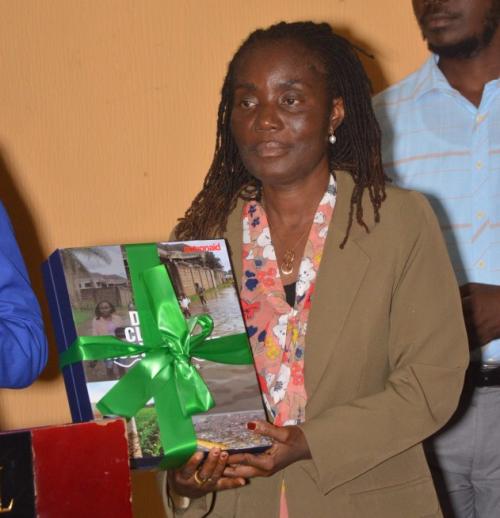
Delivering the opening remarks, ActionAid Liberia Country Director Elizabeth Gbah Johnson said the launch was not simply about presenting another report, but about confronting a global injustice that continues to shape the daily realities of Liberians.
She said the process was also intended to amplify the voices of communities on the frontlines of the climate crisis and build collective power around demands for justice, dignity, equality and accountability.
“Today is not simply about launching a report. It is about confronting a global injustice that continues to shape the daily realities of millions of Liberians,” Johnson said.
“It is about amplifying the voices of those on the frontline of the climate crisis. And it is about building collaborative power to demand a future rooted in justice, dignity, equality and accountability.”
Johnson said the theme of the report, “Who Owes Whom? Liberia’s Debt, Climate Crisis and Path to Justice,” raises a serious political, economic and moral question about the structure of the global financial and climate systems.
“The question of who owes whom is not a slogan. It is a political, economic and moral question,” she said.
“For decades, countries like Liberia have been told that we owe debts that must be repaid. Yet, the global conversation rarely acknowledges the enormous climate debt owed to countries and communities that have contributed the least to the crisis but continue to suffer its harshest consequences.”
Johnson explained that Liberia’s growing debt and increasing climate vulnerability are reinforcing one another, creating a cycle in which climate disasters generate new financing needs and force governments to borrow money to respond.
As debt repayments increase, she said, the government’s fiscal space becomes smaller, leaving fewer resources available for education, healthcare, safe drinking water, electricity, climate resilience, social protection and other essential public services.
She described the situation as a vicious cycle in which climate impacts lead to new borrowing, increased debt servicing and greater vulnerability to future climate shocks.
“It is a vicious cycle where climate impacts create new financing needs, governments borrow to respond, debt repayment increases, fiscal space shrinks, and communities are left even more vulnerable to future climate shocks,” Johnson said.
She warned that the cycle deepens existing inequalities and disproportionately affects women and girls, who often carry a heavier burden when public services fail, livelihoods are destroyed or families are displaced by climate-related disasters.
Women and girls, she noted, frequently take on increased unpaid care responsibilities when communities lose access to water, healthcare, food and other basic services.
Johnson said the issue must therefore be understood not only as a climate or debt problem, but also as a matter of economic, social and gender justice.
“This is fundamentally a matter of climate justice, debt justice, economic justice and gender justice,” she declared.
She added that every dollar saved through fair debt policies could be redirected toward education, healthcare, climate resilience and sustainable national development.
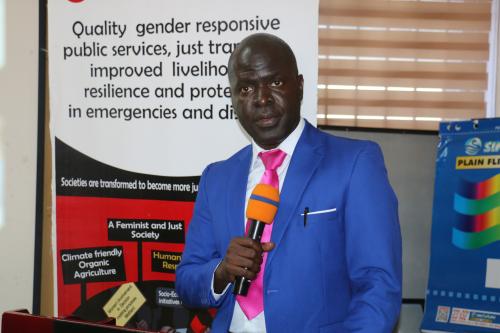
Officially launching the report, EPA Executive Director Emmanuel Urey Yarkpawolo thanked ActionAid Liberia and its partners for convening what he described as an important national conversation.
He said the report’s theme challenges Liberians and the international community to look beyond the financial debt recorded in government accounts and consider the deeper issues of historical responsibility, environmental destruction, inequality and obligations to future generations.
According to Yarkpawolo, the question of who owes whom cannot be answered by looking only at how much money developing countries have borrowed.
It must also examine which countries and industries contributed most to the climate crisis, which countries benefited from carbon-intensive development, and which communities are now paying the greatest price.
He emphasized that climate change is not merely an environmental issue.
“Climate change is not only an environmental problem. It is a governance, public finance, food security, human rights and debt problem,” the EPA Executive Director said.
Although Liberia contributes very little to global greenhouse-gas emissions, Yarkpawolo said the country continues to experience serious climate impacts, including coastal erosion, flooding and changes in rainfall patterns.
These impacts, he said, are damaging infrastructure, disrupting agriculture, destroying livelihoods and placing additional pressure on already vulnerable households and communities.
Climate disasters also force countries with limited financial resources to spend scarce public funds on emergency response, recovery and reconstruction.
At the same time, affected households may lose their homes, crops, income and other productive assets, while government revenue declines. Yarkpawolo said these conditions increase poverty and weaken the country’s capacity to prepare for and adapt to future climate shocks.
When adaptation is inadequate, he explained, the country experiences greater losses. Those losses then place additional pressure on the government to borrow money or redirect funds from other important national priorities.
Debt servicing, he warned, takes resources away from schools, healthcare, coastal protection, clean energy and other investments required to improve people’s lives and strengthen climate resilience.
“In this way, climate change is making poor countries poorer,” he said.
Liberia contributes very little to the global climate crisis, yet flooding, coastal erosion and changing rainfall patterns are affecting the country’s infrastructure, agriculture and livelihoods. Climate disasters also compel poorer countries to use scarce resources for recovery, increasing poverty and weakening their ability to adapt.
Climate finance is a responsibility, not charity
Yarkpawolo also addressed the international obligations of developed countries under the Paris Agreement.
He noted that the agreement recognizes that all countries have responsibilities in responding to climate change, but those responsibilities are not equal.
Article 9 of the Paris Agreement requires developed countries to provide financial resources to assist developing countries with climate-change mitigation and adaptation. Developed countries are also expected to lead efforts to mobilize climate finance, including public and grant-based resources for vulnerable countries and communities.
“These commitments are not acts of charity,” Yarkpawolo stressed.
He said countries and communities that benefited the least from carbon-intensive economic development are now bearing some of the greatest environmental, social and economic costs of climate change.
The EPA Executive Director warned that climate change must not become another source of unsustainable debt for countries such as Liberia.
He argued that climate-vulnerable and least-developed countries should not be forced to borrow money to rebuild infrastructure, restore livelihoods or respond to disasters caused largely by emissions from wealthier and more industrialized countries.
Yarkpawolo called for predictable and highly concessional climate financing, with greater priority given to grants rather than loans.
He also called for increased technology transfer, stronger institutional capacity and fair access to international loss-and-damage financing without unnecessarily complicated procedures.
Climate finance, he maintained, should reach the countries and communities experiencing the greatest harm rather than becoming trapped in complex international application and approval systems.
He said Liberia’s demand for accessible and grant-based climate financing is therefore a demand for international justice.
The Paris Agreement recognizes different levels of responsibility and requires developed countries to support mitigation and adaptation in developing countries. The report’s launch emphasized that such support is an obligation rather than an act of charity. Report calls for people-centered economic policies
The National Debt and Climate Audit Report calls for people-centred economic and climate policies that prioritize the needs and rights of Liberians.
It warns that excessive debt servicing can reduce the government’s ability to invest in essential services, including education, healthcare, clean and safe drinking water, electricity and climate-resilient infrastructure.
Civil society organizations supporting the report called on the government to strengthen domestic resource mobilization while ensuring that the burden does not fall disproportionately on low-income citizens and vulnerable communities.
They also called for stronger accountability in the management of public debt and climate finance.
The report argues that resources allocated for addressing climate change should primarily be provided as grants, particularly where funding is intended to help vulnerable countries adapt to impacts they did little to cause.
It further calls for reforms in the international debt system, more effective debt-relief arrangements and the careful exploration of debt-for-climate solutions.
Under properly designed debt-for-climate arrangements, part of a country’s debt may be reduced, restructured or redirected in exchange for verified investments in climate adaptation, environmental protection or resilience-building.
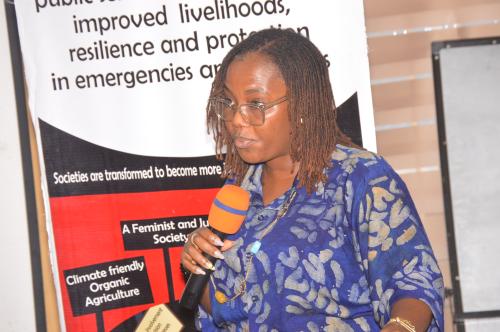
The report also calls for greater transparency regarding the difference between climate-finance commitments announced by international partners and the actual amounts disbursed and made available for implementation.
According to the report, debt and climate policies must be addressed together to protect fiscal space for public services and investments in climate resilience. Stakeholders also called for climate funding to be provided as grants rather than additional loans.
UNDP renews support for Liberia’s climate agenda
Speaking during the launch, representatives of the United Nations Development Programme renewed the institution’s commitment to supporting the Government of Liberia in addressing climate change and building national and community resilience.
UNDP said its support includes assistance for the development of Liberia’s climate-policy framework, including the National Adaptation Plan covering the period from 2020 to 2030.
The organization also highlighted its assistance to the Government of Liberia in preparing and submitting the country’s Nationally Determined Contributions under the Paris Agreement.
Nationally Determined Contributions outline the climate actions individual countries intend to undertake to reduce emissions and adapt to the impacts of climate change.
For Liberia, these commitments include actions across sectors such as agriculture, forestry, energy, coastal management, infrastructure and disaster-risk reduction.
However, the launch discussions emphasized that policy commitments alone are insufficient without adequate, accessible and predictable financing to support implementation.
The significant gap between Liberia’s climate-finance commitments and actual disbursements was therefore identified as a major concern requiring stronger international support and accountability.
UNDP reaffirmed its support for Liberia’s climate-policy development, including the National Adaptation Plan for 2020–2030 and the preparation of the country’s Nationally Determined Contributions under the Paris Agreement.
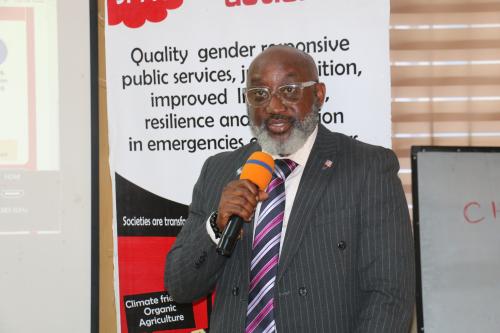
The representative said the impacts of climate change are not experienced equally across society.
When flooding, coastal erosion and changing rainfall patterns affect communities, women, children, young people and rural residents are often among those who suffer the greatest consequences.
Rural residents may lose crops and other sources of income, while women and girls may be required to travel longer distances in search of water, food, healthcare and other services.
Children may also face interruptions in their education when schools are damaged, families are displaced or household incomes are lost.
The ministry therefore called for stronger collaboration among government institutions, community movements, women’s rights organizations, youth networks and civil society groups.
Such collaboration, the representative said, is essential to ensuring that energy, debt and climate policies are informed by the lived experiences of affected communities.
“When we work together, we strengthen public trust, improve accountability and increase the chances that our energy and climate initiatives succeed on the ground,” the representative told participants.
The ministry stressed that women, children, youth and rural communities often suffer the greatest harm from flooding, coastal erosion and changing rainfall patterns. It therefore called for stronger collaboration with women’s rights groups, youth networks and community movements.
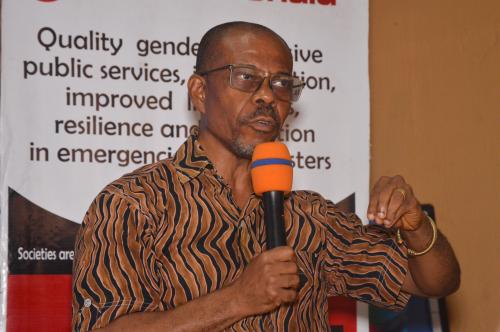
Lawrence Yealue, head of the National Civil Society Council of Liberia, and civil society advocate Dayougar Johnson stressed the importance of translating the report’s findings into concrete national action.
They warned against allowing the document to become “just another report launched” without meaningful follow-up, policy reform or measurable implementation.
The civil society leaders called for practical steps to reduce Liberia’s debt burden, improve climate-finance delivery and protect national resources for essential public services.
They also called for stronger public engagement and sustained advocacy to ensure that decision-makers remain accountable for commitments made around debt justice and climate action.
Their interventions reinforced a major message running throughout the launch: the report should be treated as an advocacy and policy instrument rather than as the conclusion of the process.
Civil society leaders Lawrence Yealue and Dayougar Johnson called for practical action to address Liberia’s debt crisis and climate vulnerability, warning that the audit must not become “just another report launched.”
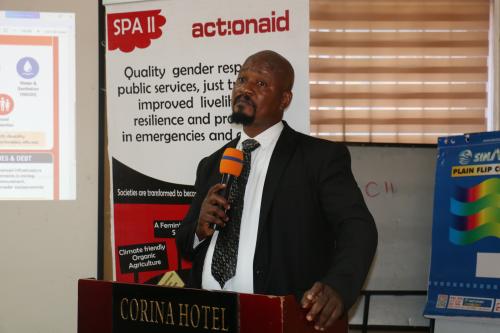
Yealue reminded delegates that climate change is a global crisis largely created by industrialized nations, yet countries such as Liberia, which have contributed very little to global greenhouse gas emissions continue to bear some of its most devastating consequences.
"Debt justice is the foundation of this conversation," Yealue said. "What that means is that the burdens created by problems we did not cause should not continue to be placed on countries like Liberia."
He questioned the fairness of a global climate system that places significant restrictions on Liberia's natural resources while the country contributes only a tiny fraction of global carbon emissions.
"Liberia accounts for only about 0.3 percent of global emissions, yet we are told not to fully utilize our forests, which remain one of our greatest natural assets," he said. "That cannot be considered a genuine or equitable solution to the climate crisis."
Yealue further described the difficult reality facing Liberia, noting that coastal erosion, flooding, and other climate-related disasters are becoming increasingly visible across the country. Despite these growing impacts, he said, Liberia continues to shoulder rising national debt while lacking sufficient domestic resources to adequately finance climate adaptation and disaster response.
Instead, he noted, the country is often forced to depend on external financing that frequently comes in the form of loans, further increasing its debt burden.
"This cycle is placing additional pressure on an already fragile economy," Yealue warned. "Countries that have contributed the least to climate change should not be pushed deeper into debt simply to recover from a crisis they did not create."
He called on the international community to pursue fairer and more equitable climate financing, stressing that climate-vulnerable countries like Liberia deserve grant-based support and debt justice rather than additional financial burdens.
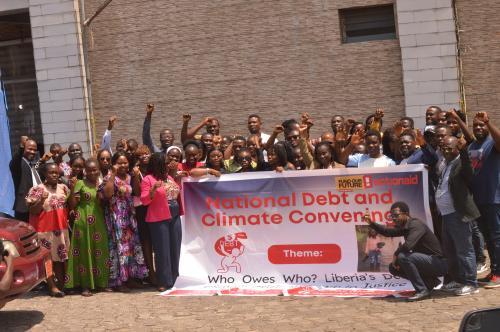
The organizations are calling for fair debt policies that create greater fiscal space for investment in healthcare, education, water, electricity, climate resilience and sustainable development.
They are also demanding accessible and grant-based climate financing for countries such as Liberia, which have contributed little to the climate crisis but are experiencing severe consequences.
The report further calls for stronger domestic resource mobilization, transparent management of public debt, accountable delivery of climate finance and meaningful participation by communities in decisions affecting their lives.
Participants agreed that Liberia’s rising public debt and increasing climate vulnerability must no longer be addressed as separate national challenges.
Climate disasters create new financial pressures. Borrowing to respond to those disasters increases debt. Higher debt repayments reduce the money available for public services and climate adaptation. Weak adaptation then exposes communities to even greater losses when the next disaster occurs.
Breaking that cycle, the report concludes, will require action from the Government of Liberia, international financial institutions, developed countries, development partners, civil society organizations and community movements.
For ActionAid Liberia and its partners, the launch marked the beginning of a wider advocacy effort aimed at ensuring that Liberia does not continue borrowing to address a climate crisis it did little to create.
As the country confronts flooding, coastal erosion, changing rainfall patterns and growing pressure on livelihoods, the report’s central message remains clear: debt justice, climate justice, economic justice, gender justice and social justice must advance together.
Every dollar protected through fairer debt arrangements can become an investment in schools, hospitals, clean water, resilient infrastructure, climate adaptation and the dignity and wellbeing of the Liberian people.